
This Is What We Built · and Why It Still Works
The Woodlands was designed as something specific: a community where the forest stayed, the water stayed visible, and the public realm was worth caring about. These five frames remind me why that original discipline still holds.


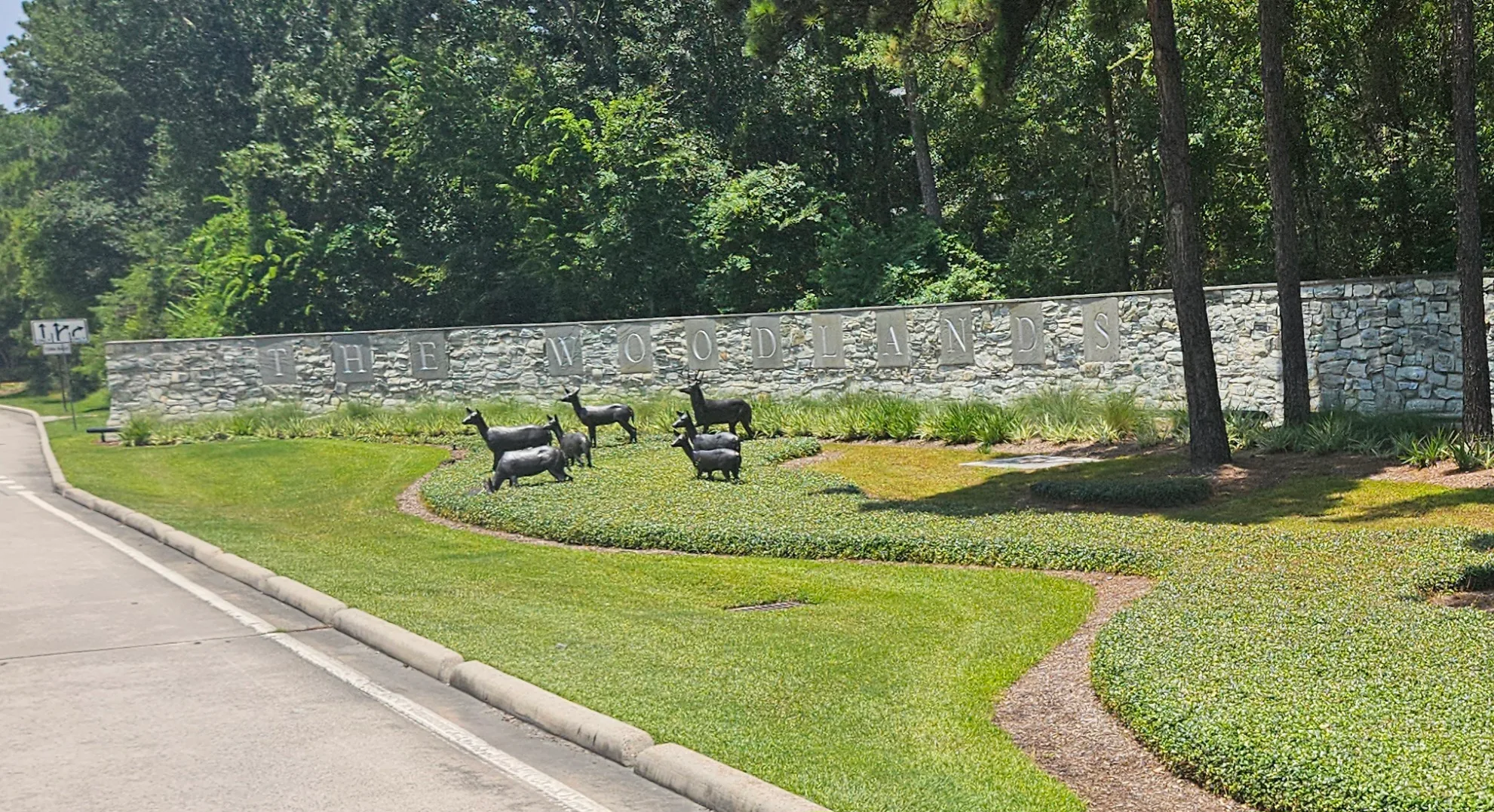
There is a stone entrance wall on the north edge of town"THE WOODLANDS" carved in block letters across its face, five bronze deer mid-stride across the landscaped median in front of it, that I have driven past more times than I could count. I notice it differently depending on the season. In summer, the loblolly pines behind it are so dense and dark green they look almost coastal. The deer sculpture never moves, and somehow that stillness makes it feel more alive than a lot of things that do.
That entrance is a promise. What I want to talk about today is whether the rest of the community keeps it, and what I see when I look at where we actually are.
The Waterway as civic spine
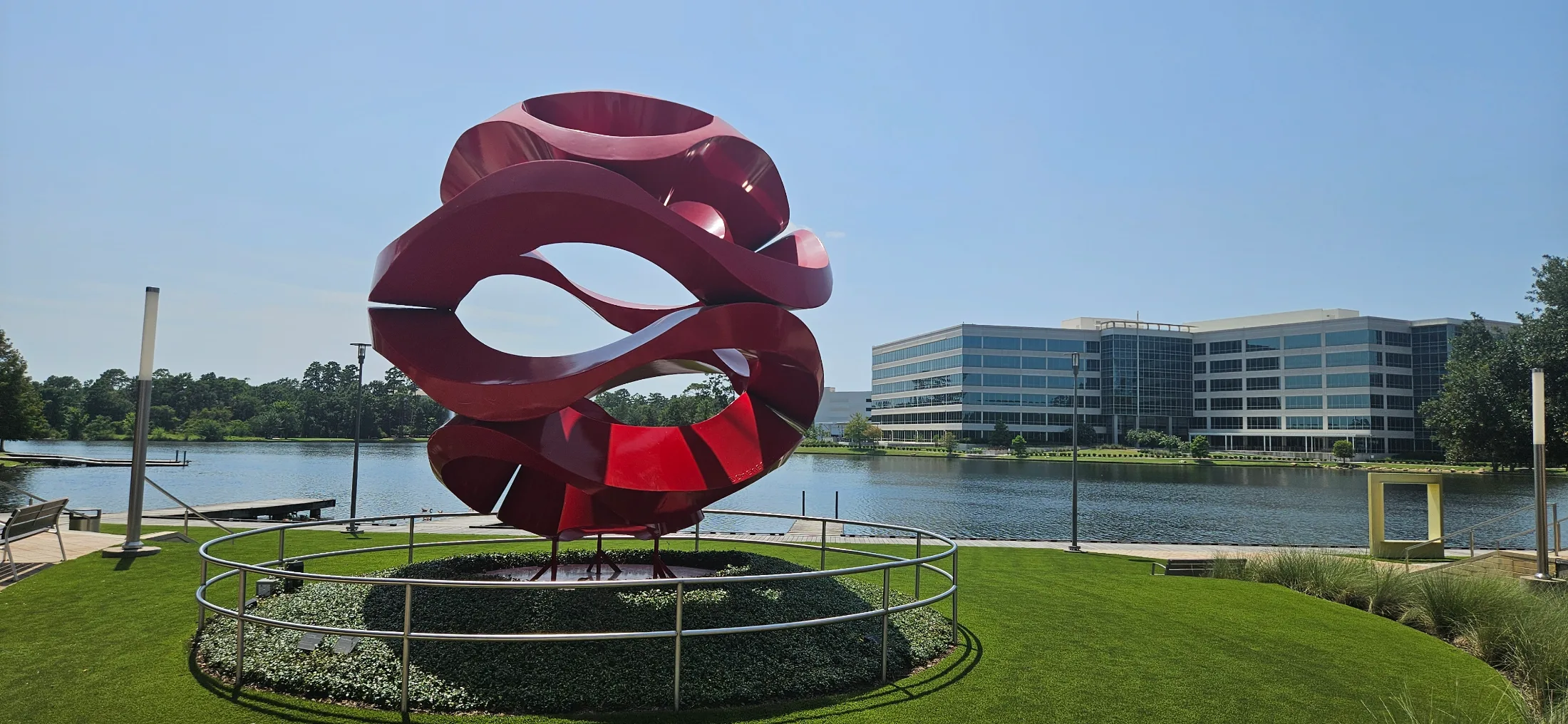
The large crimson sculpture installed along the waterfront, a looping, interlocking form in deep lacquered red, rising above a circular hedge planting, sits against the open water with a glass-and-steel office tower visible on the far bank. The pairing is intentional. This community has always understood that commerce and beauty are not competing priorities. The sculpture is bold enough to hold its own against the scale of the building behind it, and the lawn leading to the water's edge is maintained with the kind of care that signals the space is genuinely valued, not just permitted.
What that installation gets right is specificity. It is not generic public art. It has a visual weight and a chromatic confidence, that particular red against the Texas summer sky, that makes you stop and orient yourself. Public space earns its keep when it gives people a reason to pause. This one does.
The pavilions, and the case for shade
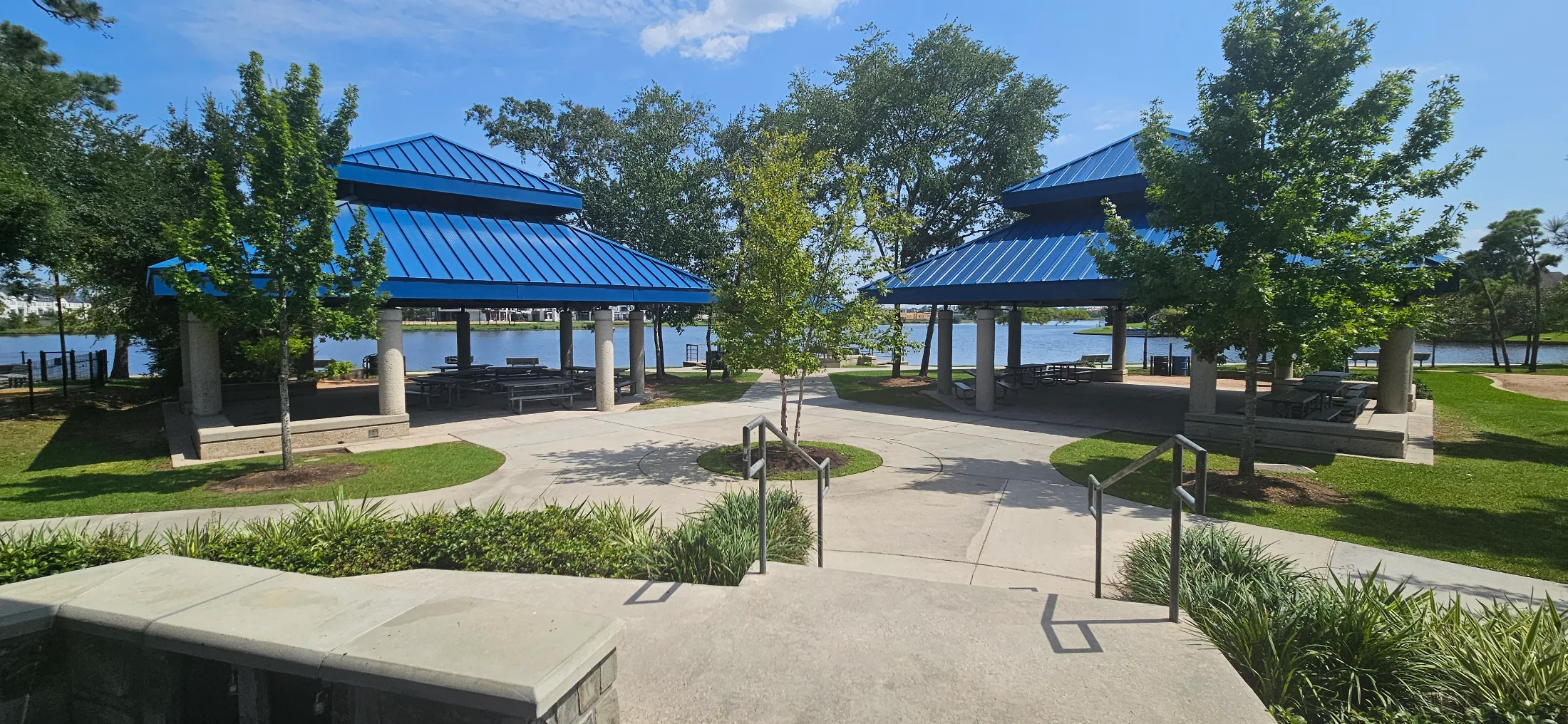
Two lakeside pavilions with cobalt-blue standing-seam roofs face each other across a wide paved plaza, picnic tables arranged beneath each one, young trees planted in the median between them. The water is immediately behind. On a July afternoon in Montgomery County, shade is not an amenity, it is infrastructure. The decision to build permanent covered structures at the water's edge, rather than leaving residents to manage with portable canopies and goodwill, reflects a genuine understanding of how outdoor space gets used here versus how it gets used in, say, a temperate climate.
The blue roofline is also a choice worth acknowledging. Someone decided the pavilions should be visible, should read as destinations rather than afterthoughts. The result is a lakefront that looks like it belongs to the people who live around it, which is the point.
Golf as landscape
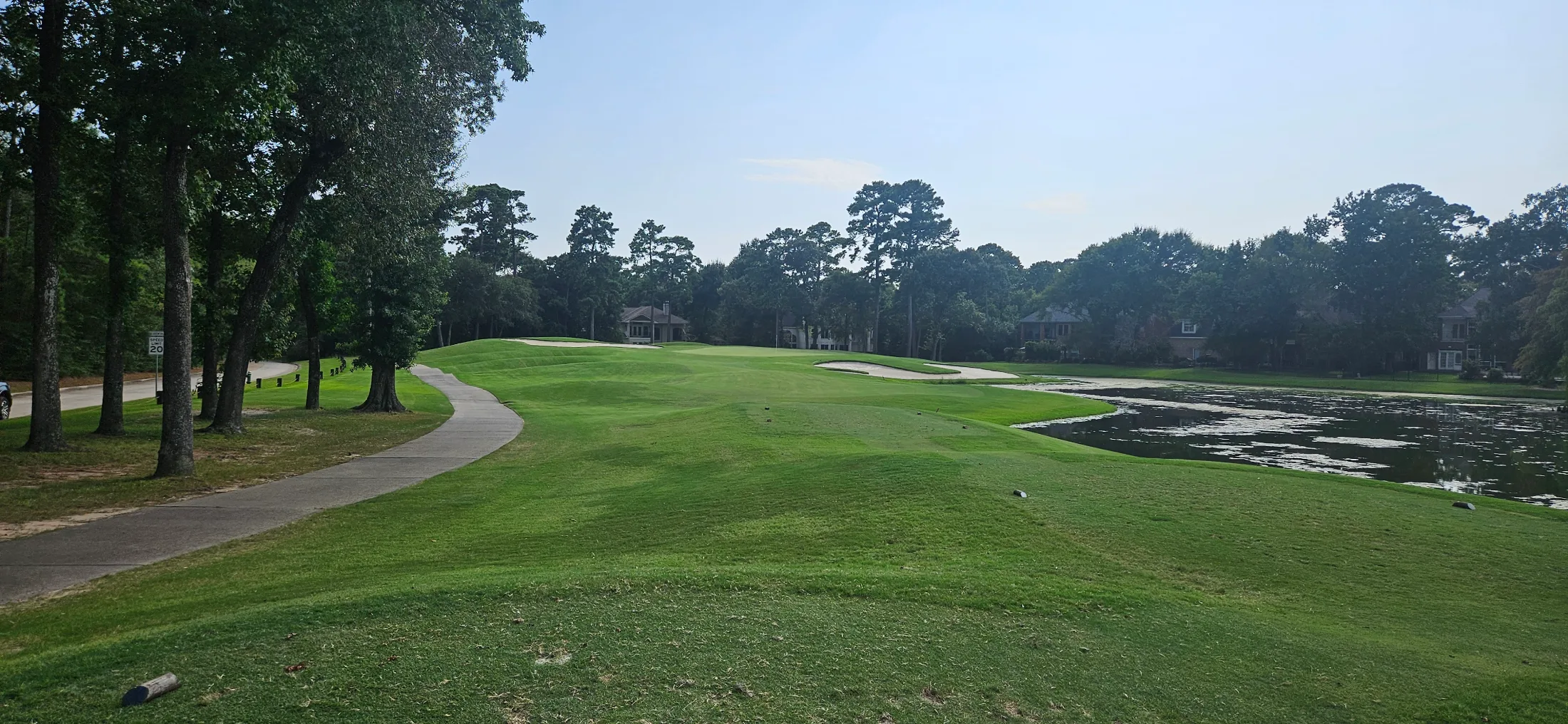
A fairway winds between tall pines and a water hazard on the right side, sand traps guarding a green in the middle distance, substantial homes sitting just beyond the tree line. This is what golf-course living looks like when the golf course was laid into the existing forest rather than carved out of cleared land. The pines were here first, and the course respects that sequence. The cart path curves where the trees dictate.
The Woodlands has always treated its golf courses as part of the larger green infrastructure, corridors that connect open space, manage water, and give the residential streets behind them a breathing room that does not appear on a square-footage calculation. That photograph shows the logic plainly: you are standing in a neighborhood and also standing in a forest, and neither fact cancels the other.
The lifeguards at the pool
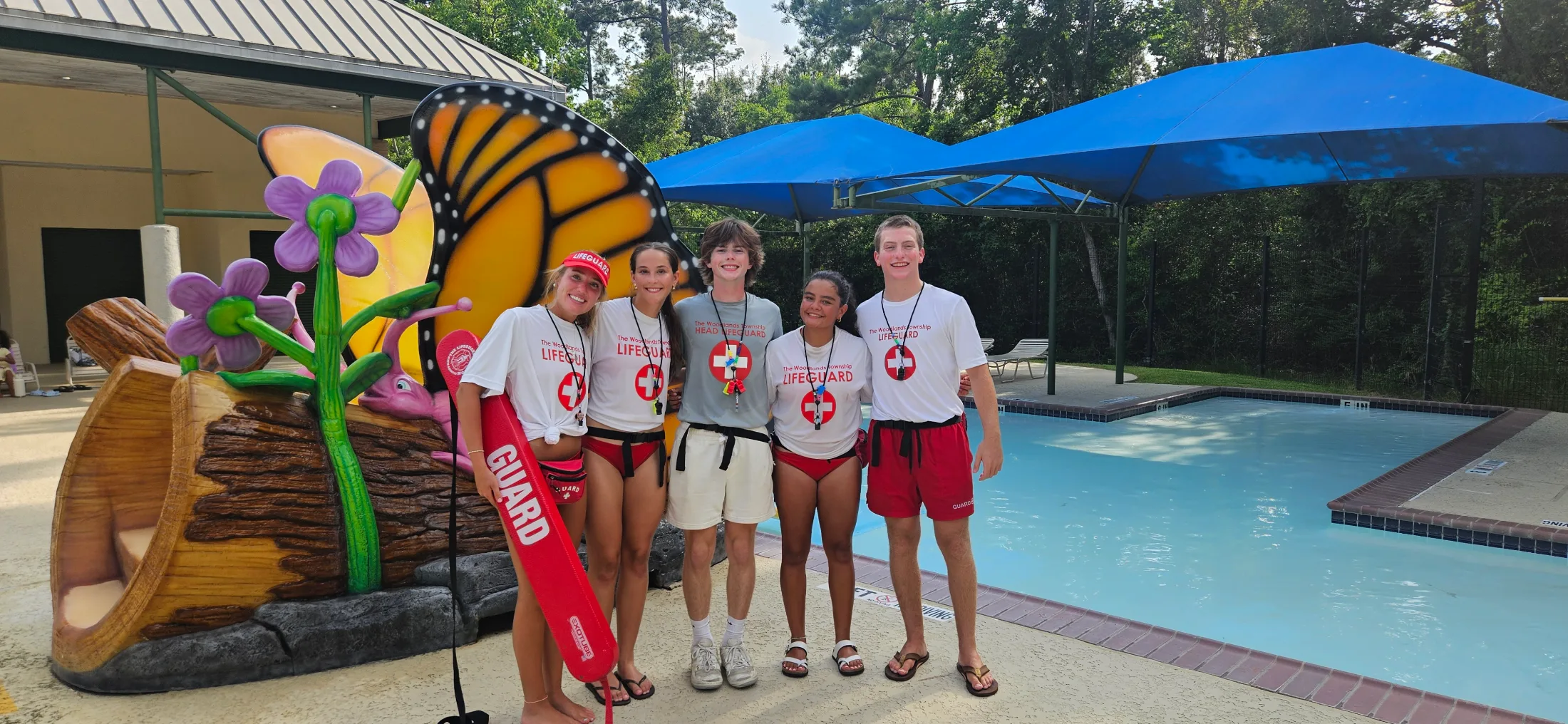
Five Woodlands Township lifeguards stand together at a community pool, four in white "LIFEGUARD" tees, one in a gray "HEAD LIFEGUARD" shirt, all in the red shorts that mark the role. Behind them, a whimsical monarch butterfly play structure anchors a splash area, and blue shade umbrellas cover the deck. One guard holds a red rescue tube.
This is the frame that stays with me longest. Those are local kids working a community job, staffing a pool that belongs to the neighborhoods they grew up in. The Township pools are not incidental, they are where summers happen for families in Cochran's Crossing and Grogan's Mill and College Park. The fact that the pool itself is designed with young children specifically in mind, with the oversized butterfly sculpture and the shallow splash zone, means someone thought carefully about who shows up and what they need when they get there.
A premium community earns that designation not just through its entry monuments or its public sculpture or its golf corridors, though all of those matter. It earns it through the consistency of care across the full spectrum of what residents actually use, from the stone wall at the entrance to the teenager holding the rescue tube on a Tuesday afternoon in August.
The promise at that entrance wall holds. That is not something I say lightly, and it is not something that happens without sustained attention. It takes decisions made at the level of roofline color and pavilion placement and sculpture scale and pool staffing, made by people who understand that a community's character is the sum of those specifics, not a mission statement, not a marketing phrase, but the actual daily experience of the place.
We are that place. The work is to stay that place.
I'm Rick Raanes, founding Market Mayor of The Woodlands and the first ambassador for Livin.in. After 25 years in the Houston area, 22 years in real estate, and more than 1,000 homes sold, I've learned that loving where you live is about more than the house. It's about the people, local businesses, and experiences that make a community special. My goal is to share those stories, build meaningful connections, and help people discover more of what makes The Woodlands a great place to call home. Relationships over transactions. Always.