
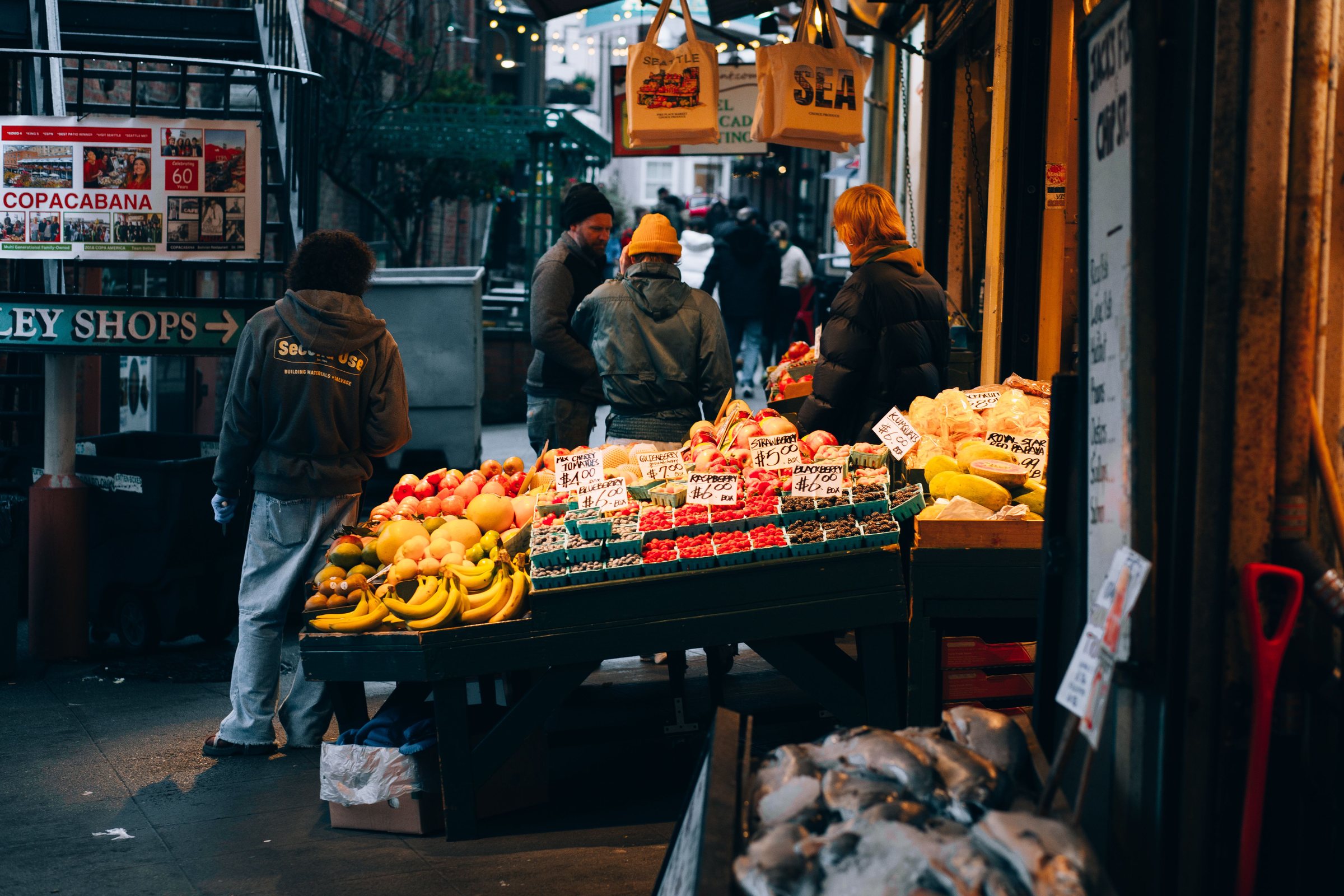
Pike Place Market opened on August 17, 1907. Its mission and founding goal is allowing consumers to "Meet the Producer." Local farmers and craftspeople sell year-round in the arcades, from tables they rent from the market on a daily basis. The market overlooks the Elliott Bay waterfront on Puget Sound, and it is named for its central street, Pike Place, which runs northwest from Pike Street to Virginia Street on the western edge of Downtown Seattle.
The upper street level contains fishmongers, fresh produce stands and craft stalls in the covered arcades. At Pike Place Fish Market, employees throw three-foot salmon and other fish to each other rather than passing them by hand. The market's unofficial mascot is Rachel, a 550-pound bronze piggy bank designed by local artist Georgia Gerber, which has been at the corner of Pike Place under the Public Market Center sign since 1986. Rachel receives roughly $6,000 to $9,000 a year in just about every type of world currency, and the Market Foundation collects that money to fund the market's social services.
Pike Place Market is Seattle's most popular tourist destination, with more than 20 million annual visitors. The market is built on the edge of a steep hill and has several lower levels below the main level. Those lower levels feature shops such as antique dealers, comic book and collectible shops, and small family-owned restaurants.
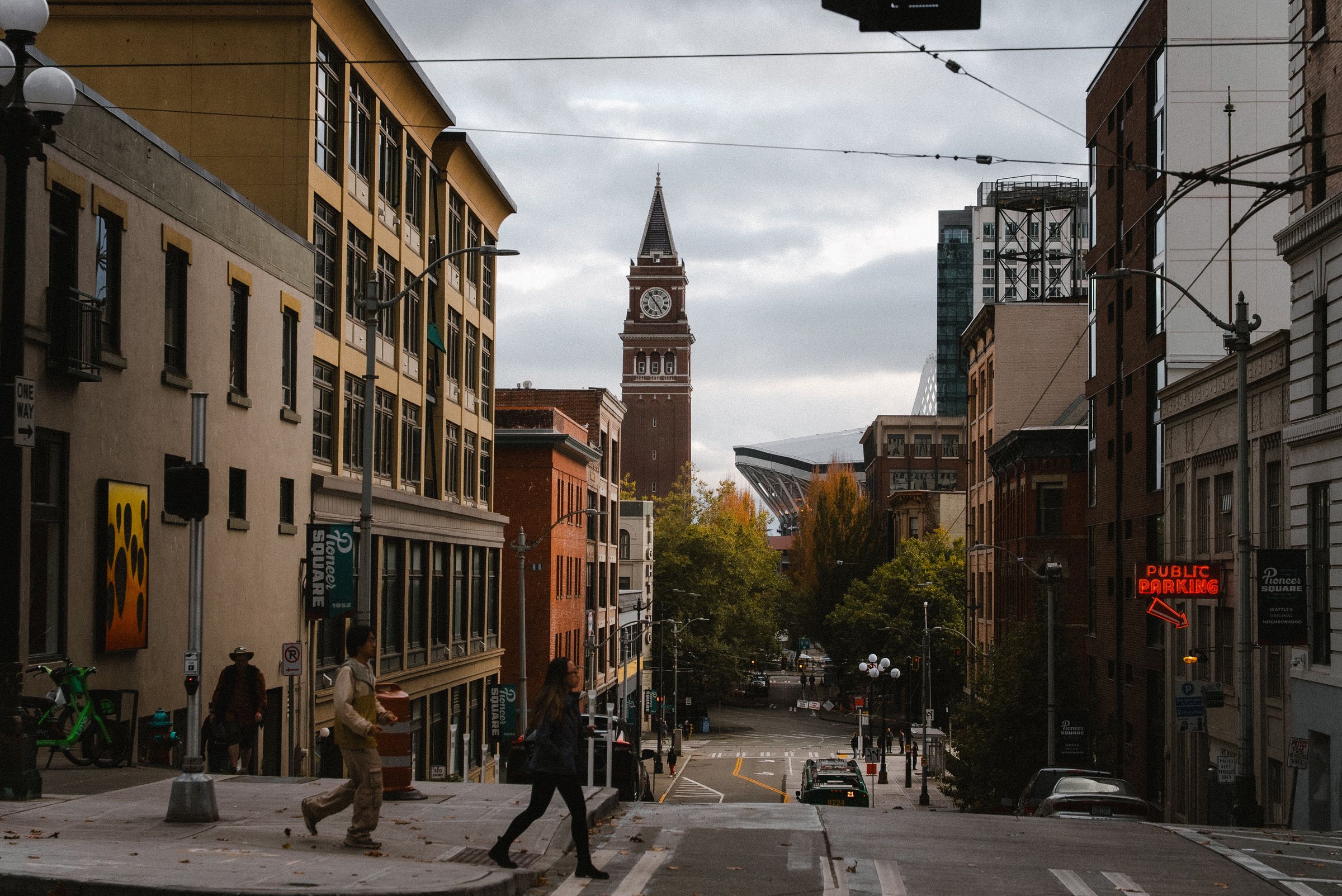
Pioneer Square, a neighborhood in the southwest corner of downtown Seattle, was once the heart of the city. Seattle's founders settled there in 1852. The neighborhood's early structures were mostly wooden, and nearly all of them burned in the Great Seattle Fire of 1889. By the end of 1890, dozens of brick and stone buildings had been put up in their place, mostly Richardsonian Romanesque, and the neighborhood's architectural character still comes from those buildings.
King Street Station opened on May 10, 1906. The station's clock tower and main entry terminate the axis of King Street in Pioneer Square. The station's 242-foot tower was modeled after the recently collapsed Campanile di San Marco in Venice, Italy. The station is served by Amtrak's Cascades, Coast Starlight and Empire Builder, and by Sounder commuter trains.
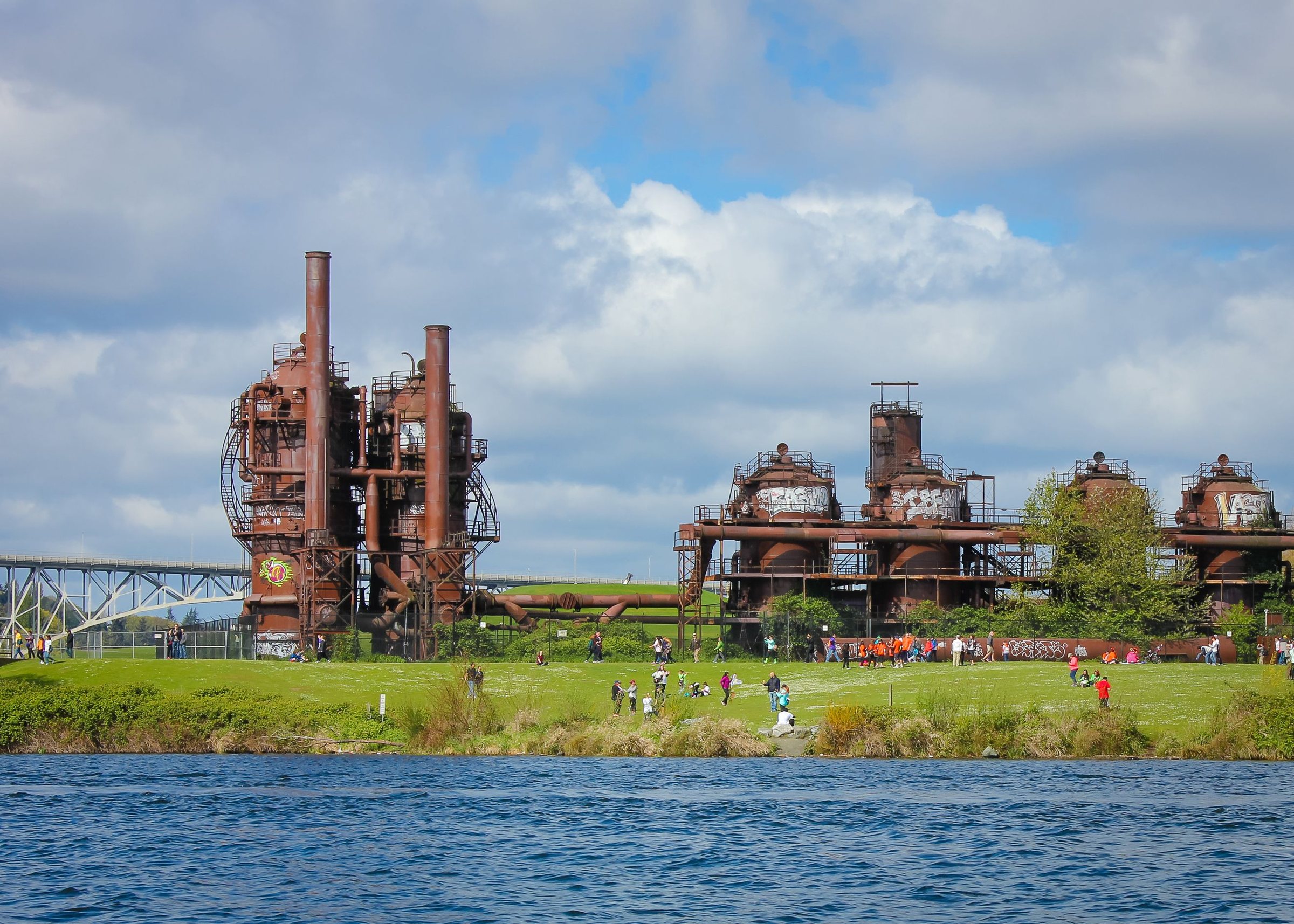
Gas Works Park is on the site of the former Seattle Gas Light Company gasification plant, on the north shore of Lake Union at the south end of the Wallingford neighborhood. The plant operated from 1906 to 1956, and the park contains remnants of the sole remaining coal gasification plant in the United States. The park opened to the public in 1975, and it was added to the National Register of Historic Places on January 2, 2013, over a decade after being nominated. It was designed by Seattle landscape architect Richard Haag, who joined the University of Washington faculty in 1958 and founded its Landscape Architecture Program.
Some pieces of the old plant stand as ruins. Others have been reconditioned, painted and incorporated into a children's "play barn" structure, constructed in part from what was the plant's exhauster-compressor building. The park's towers, play barn and picnic shelter are adapted from the original manufacturing structures. The park also has an artificial kite-flying hill with a sculptured sundial built into its summit.
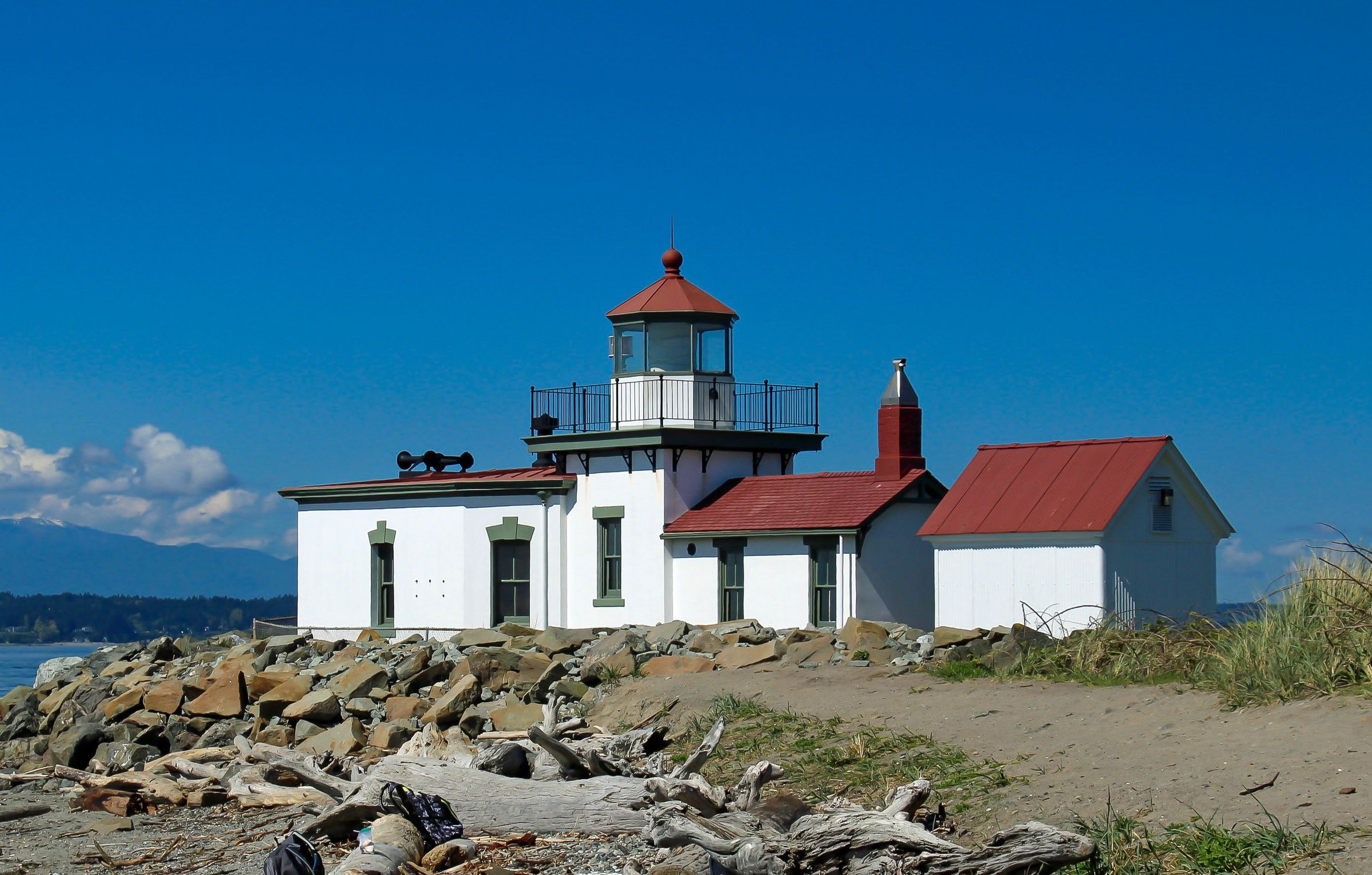
Discovery Park is a 534-acre park on the shores of Puget Sound in the Magnolia neighborhood of Seattle, built on the historic grounds of Fort Lawton. As the city's largest public park, it contains 11.81 miles of walking trails, and forests, beaches, prairies and bluffs dominate its landscape. The Discovery Park Loop Trail, designated a National Recreation Trail in 1975, runs 2.8 miles through the park. Most visitors enjoy hiking the Loop Trail, which forms a circuit through forest, meadow and shrub habitats around the upland portion of the park, with excellent views of Puget Sound. The West Point Lighthouse is on West Point, the westernmost point of the park and of the entire city of Seattle. The lighthouse began operation on November 15, 1881, and it was the first staffed light station on Puget Sound. The lighthouse was added to the National Register of Historic Places in 1977, and the light keeps its original characteristic of alternating red and white flashes every five seconds. The hike back up from the north beach is mildly strenuous.
In an average year in Seattle, at least 0.01 inches of precipitation falls on 150 days. Seattle sees frequent but light rainfall between October and May, with rainfall becoming lighter and sparser between June and September. In November, Seattle averages more rainfall than any other U.S. city of more than 250,000 people. Because Seattle often has merely a light drizzle for many days, it receives significantly less precipitation overall than New York City, Miami or Houston.
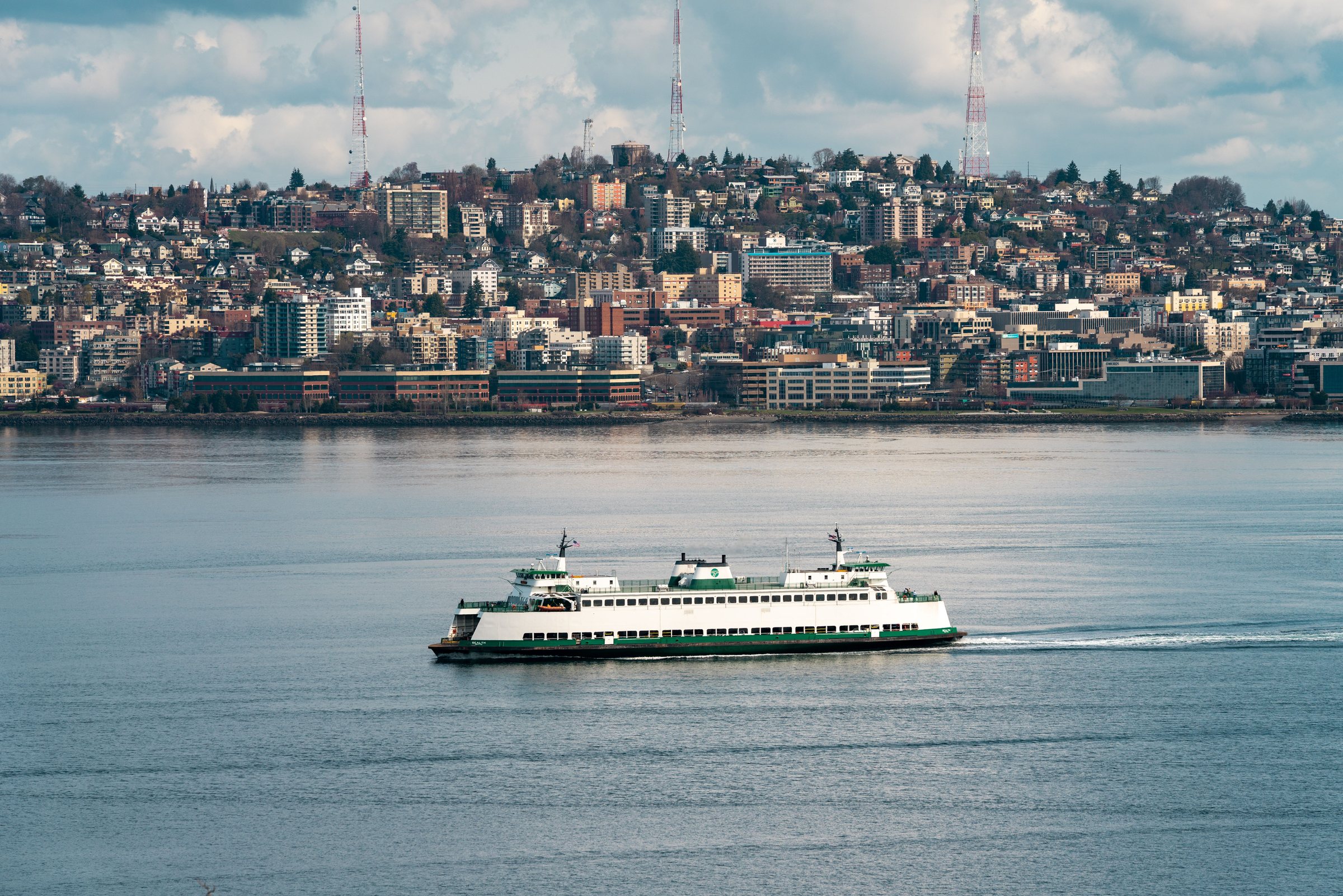
Washington State Ferries is the largest ferry system in the United States, and its flagship terminal is Colman Dock in Downtown Seattle. Its busiest route is the Seattle to Bainbridge Island ferry, which carried 5.2 million total riders in 2025. Where You LIVE.