
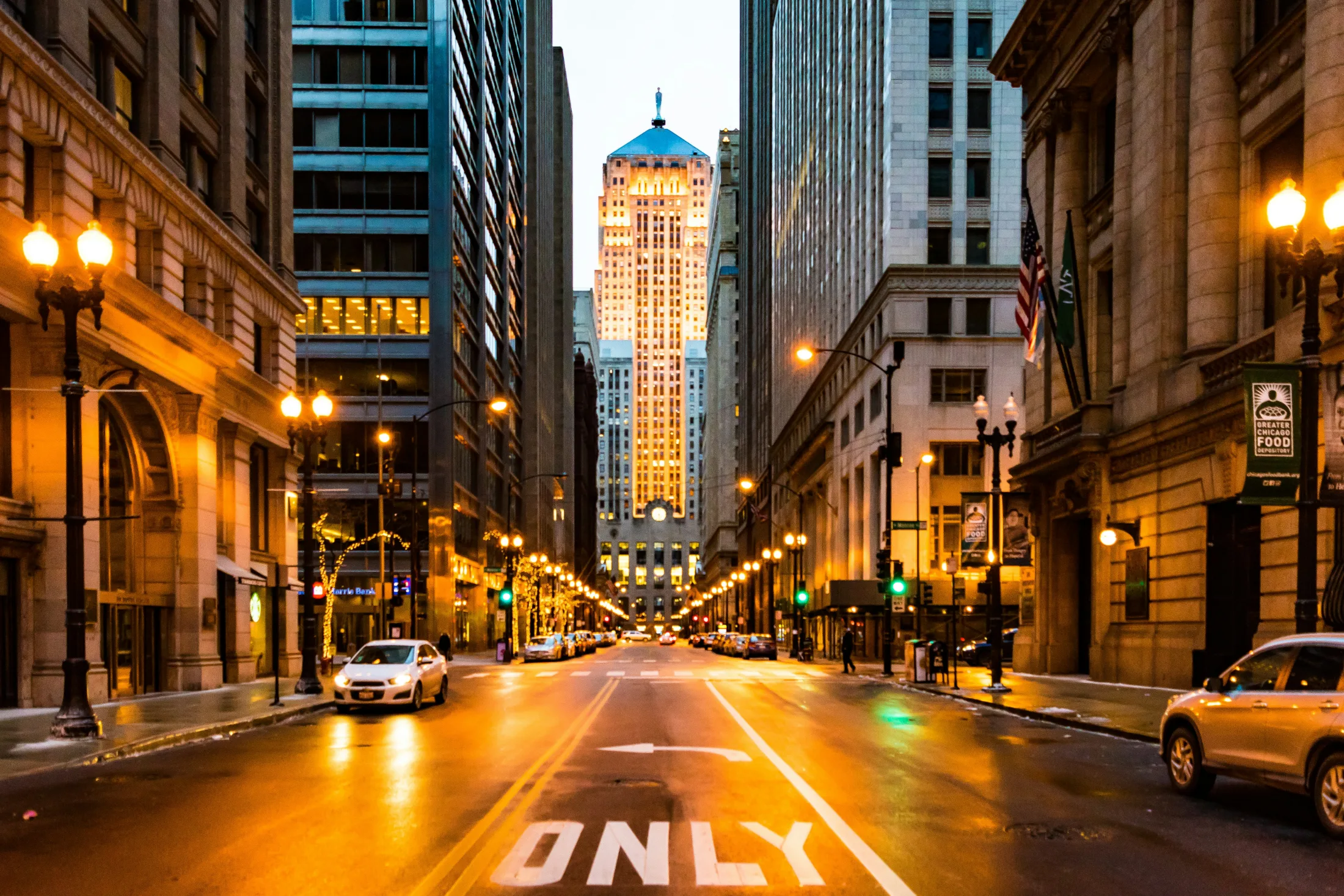
The tab you keep closing? That's not restlessness. That's your gut running the numbers. Here's what the city is actually putting on the table.
1. The Scale of Opportunity Changes the Math
There's something specific that happens when you walk down a city street at night and every lit window represents a different company, a different studio, a different someone building something. That picture above — golden streetlamps receding toward a tower of lit offices — isn't atmosphere. It's the visual fact of density. More people means more industries, more employers, more paths that don't require you to pick one thing and stick with it forever.
In a big city, career pivots are possible because the job market is deep enough to absorb them. Freelancers find clients. Creatives find audiences. People who want to work across three fields at once often find a way to do exactly that. The opportunity isn't abstract — it's a function of how many people and institutions are within reach on any given Tuesday.
Mount Shasta has its own version of this: the entrepreneurial spirit that comes from people who chose to build something in a place most people overlook. If that's already speaking to you, read about what moving here in 2026 actually looks like. If you're still weighing the city, keep going.
2. Nobody Has the Bandwidth to Judge You

In smaller places, standing out takes courage. In a city, it takes getting dressed. The woman in that photo — red lip, sunglasses on her head, planted squarely on the sidewalk like she owns the block — isn't performing for anyone. She's just being. The city gives you that. Nobody has the bandwidth to judge your outfit, your food order, your career change, or your Saturday plans.
That kind of anonymity sounds cold until you experience it as freedom. Cities attract people who are figuring themselves out, which means the social pressure to already have it figured out drops considerably. You can try on a new neighborhood, a new crowd, a new version of yourself — and if it doesn't fit, you try something else. The city is big enough to hold all of your drafts.
3. Your Commute Becomes Part of Your Day, Not a Tax on It

Mid-crosswalk, hair moving, not a sign of stress. That's not a commute. That's just Tuesday. One of the most underrated things about city life is that walking becomes your default transit mode, and walking through a real city is never boring.
You notice things. A new restaurant where the dry cleaner used to be. A protest. A street musician who plays the same corner every Thursday and has somehow become part of your weekly rhythm. None of this happens in a car on a highway. The city compresses geography in a way that makes daily movement feel like participation rather than obligation. You're not driving to your life — you're already in it.
This is what people miss most when they leave cities. The walkability. The texture of moving through a place on foot. It doesn't show up on spreadsheets, but it shows up constantly in daily experience.
4. Culture Isn't Something You Drive To
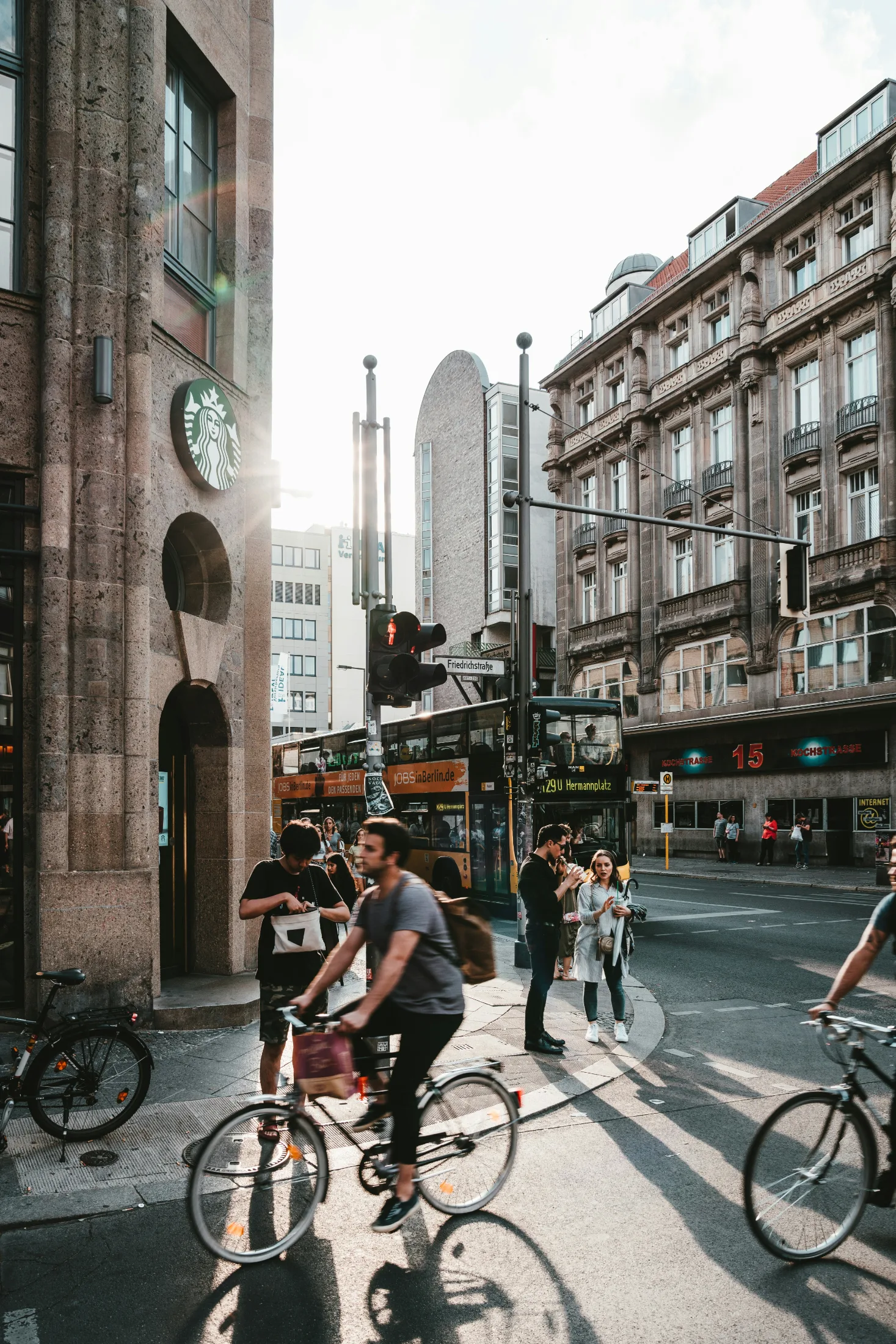
That street scene — cyclists cutting through the intersection at Friedrichstraße, a double-decker bus in the background, sunlight flooding between century-old stone buildings, strangers mid-conversation on the corner — that's not a weekend. That's a Wednesday afternoon. In a dense city, culture isn't scheduled. It's the default state of the street.
In practice: you stumble into a gallery opening because it's in the same building as your coffee shop. You catch a film you'd never have sought out because the independent cinema is two blocks away and the showtimes are convenient. You eat food from countries you've never visited because the restaurant is right there and it's good and you go back. Cities compress the world into a walkable radius, and over time that shapes how broadly you think, eat, listen, and connect.
The steady accumulation of those low-effort exposures is hard to replicate anywhere else. They don't feel like enrichment in the moment — they feel like just going about your day. That's the point.
5. Loneliness Is Actually Harder to Sustain
This one surprises people. Cities have a reputation for isolating millions in close proximity. That reputation has a kernel of truth, and city loneliness is real. But so is this: when you want connection, the infrastructure for it is everywhere. Reading groups, running clubs, bar trivia, neighborhood associations, climbing gyms, weekend markets, a dozen varieties of class and practice and gathering. The difference from a small town isn't that connection is easier to stumble into — it's that when you're ready to look, it's available at scale.
The city rewards initiative in ways that quieter places don't. Show up consistently somewhere — a coffee shop, a gym, a weekly market — and you become a regular. Regulars become neighbors. Neighbors become the people you call. It takes longer than it does in a place where everyone already knows everyone, but what you build tends to be chosen rather than inherited. That means it tends to fit.
This dynamic runs both directions. In Mount Shasta, a small city can feel deeply connected or deeply isolating depending entirely on how you enter it. One year in, it still surprises people.
The Tab You Keep Closing
Open it again — but this time, know what you're actually deciding. Not whether the city is perfect. Whether the particular friction of city life produces something you want more than the thing you'd be trading it for. Most people who make the move don't say it was easy. They say it was right. That's a different endorsement, and it's the honest one.