
Matthew Kocel and Ari Urban Brought Sacred Sound to Soul Connections · and Mount Shasta Was the Perfect Witness
Cosmic throat singer Matthew Kocel and violinist Ari Urban came to Soul Connections Community Center. The mountain watched through the windows. The room felt every note.


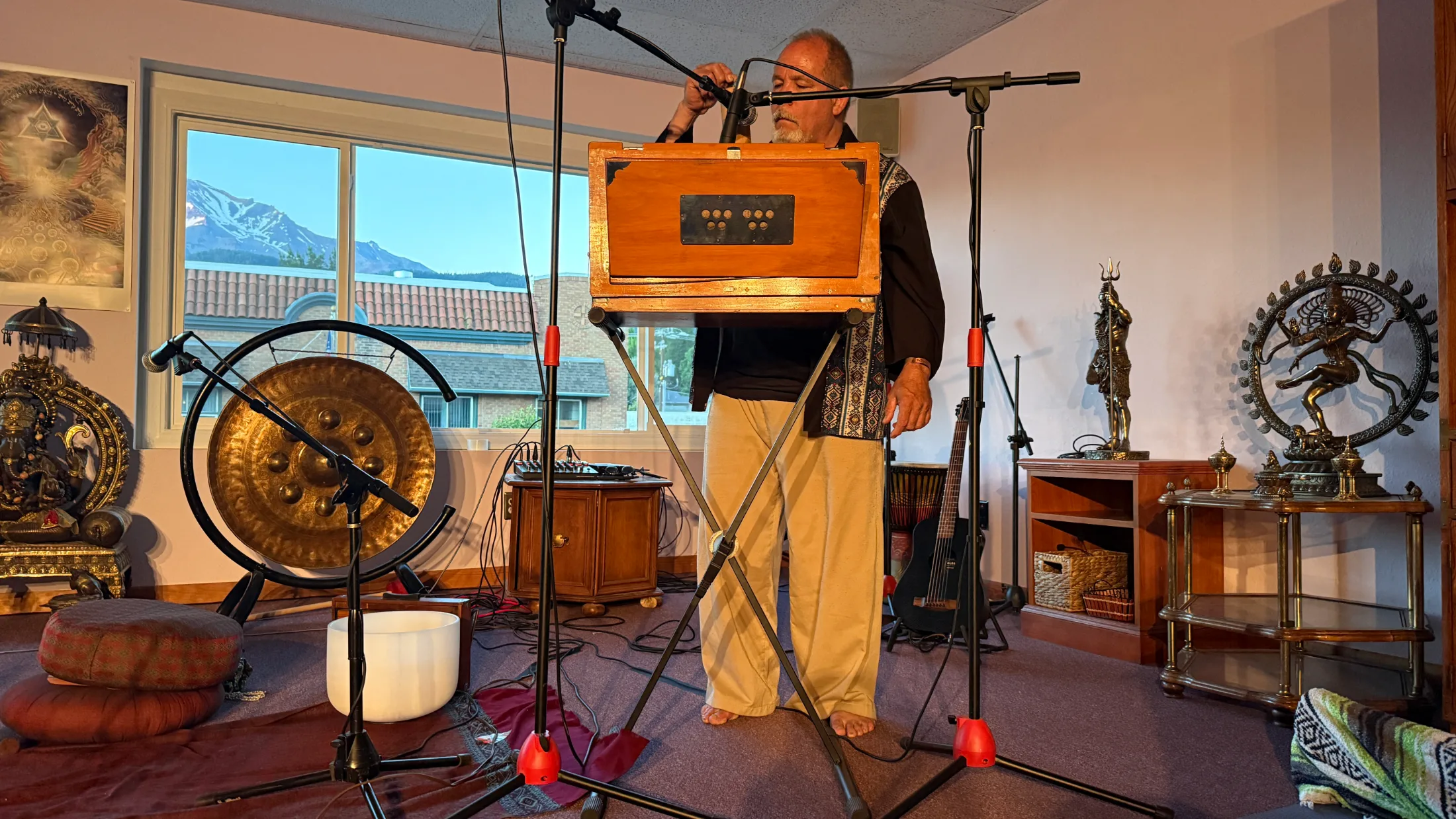
Before Matthew Kocel played a single note at Soul Connections Community Center last night, the room had already made its case. Barefoot on the carpet, he stood at a wood-paneled harmonium, microphone close enough to catch every overtone. To his left: a brass gong, a crystal singing bowl, meditation cushions arranged on the floor. To his right: a bronze Nataraja, Shiva mid-dance, watching from a side table. And through the window, framed like a deliberate choice, the mountain. Snow still on the upper ridgeline. That particular late-day light that makes the peak look like it's generating its own glow.
Kocel and violinist Ari Urban each performed solo sets before coming together. The combination, resonant throat singing layered against violin, vocal harmonics folding into spontaneous musical prayer, resists easy genre tags. It lands somewhere between Mongolian overtone tradition and something genuinely improvised in the moment, tracking the room. That responsiveness is the point. This wasn't a playlist with live accompaniment. It was closer to a conversation between performers and the people seated around them, the kind where you don't realize you've stopped shifting in your seat until it's over.
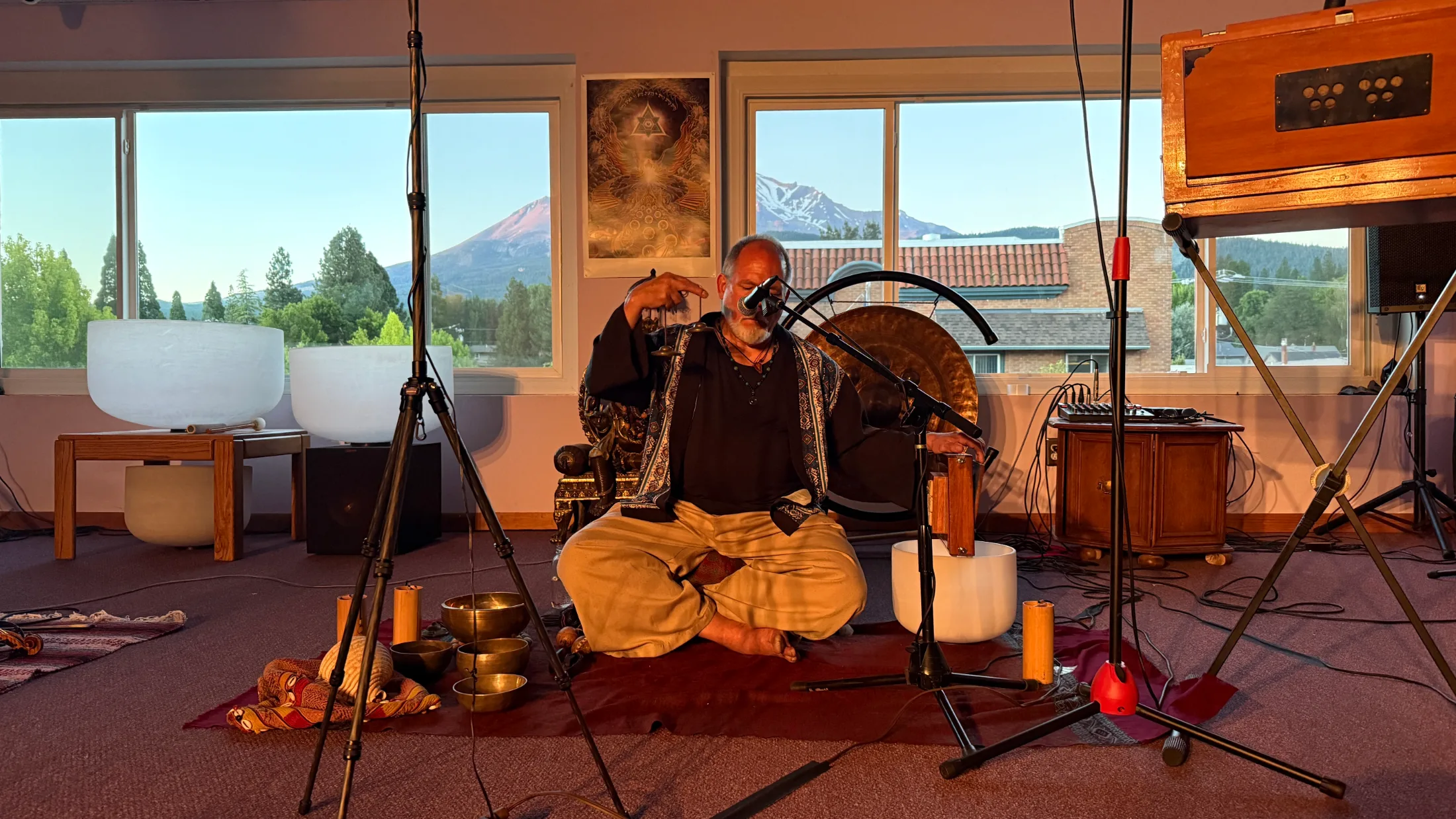
By the time Kocel moved to the floor, cross-legged on a red cloth, Tibetan singing bowls within reach, crystal bowls catching the fading light, the mountain outside had gone that deep orange-pink that only holds for about fifteen minutes at dusk here. Mount Shasta was doing what it does. It stops you cold even when you think you've seen it a hundred times.
Mount Shasta draws this kind of event for reasons that have nothing to do with brochure copy. There's a specific gravity here, something in the altitude, the silence between sounds, the way people who move through this place often show up to an evening like this already opened up, already listening. People don't stumble into this town by accident. Artists who choose to perform here tend to know that the audience already understands what they're reaching for, which changes what's possible onstage.
This room has held that kind of charge before. Simrit Kaur brought the Naad here and the room felt it the same way. There's a lineage forming, not a festival brand or an institution, just a run of evenings where the right people showed up and something unrepeatable happened.
Soul Connections gave it the right container. Small enough that you felt the gong's resonance in your sternum from across the room. The instruments, harmonium, bowls, gong, all of it on a carpeted floor without a riser or a backdrop, made the whole thing feel less like a ticketed event and more like being let into someone's practice. The lack of production design was the production design.
Kocel and Urban will move on to the next date. The mountain will keep doing what it does. What stays is the specific memory of that room, that dusk light, and two performers who treated stillness like an instrument they'd been playing for years.
- Address
- 329 N Mt Shasta Blvd, Mt Shasta, CA 96067
- Phone
- (530) 918-9533