
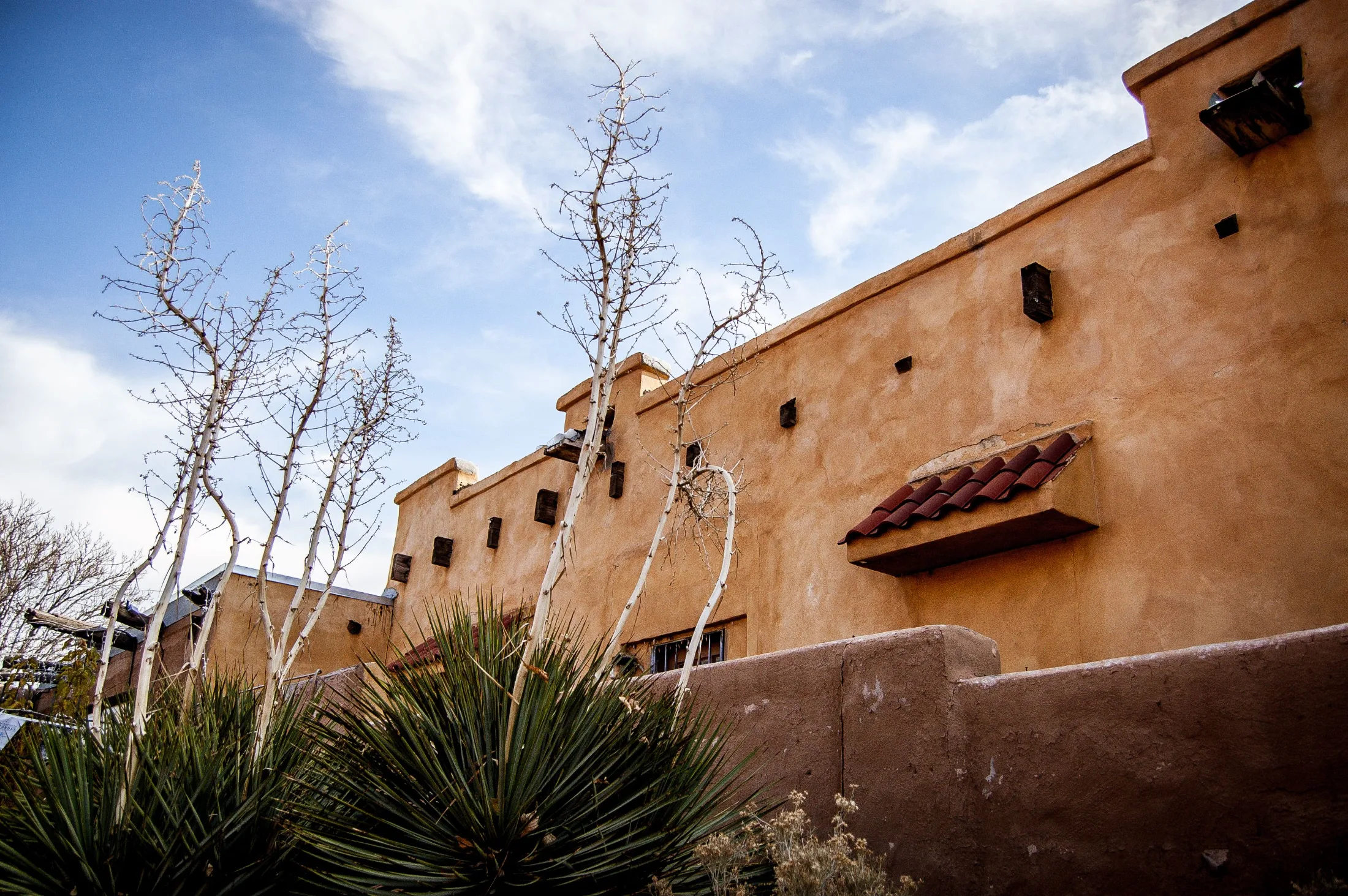
The sky above Santa Fe is a specific blue — most saturated in late morning, when the altitude strips out the haze and leaves a color so deliberate it looks painted. Photographers chase it. Painters have been trying to pin it down for a century. You stop noticing it around year two, start seeing it again around year five, and after that it just becomes part of how you read the day.
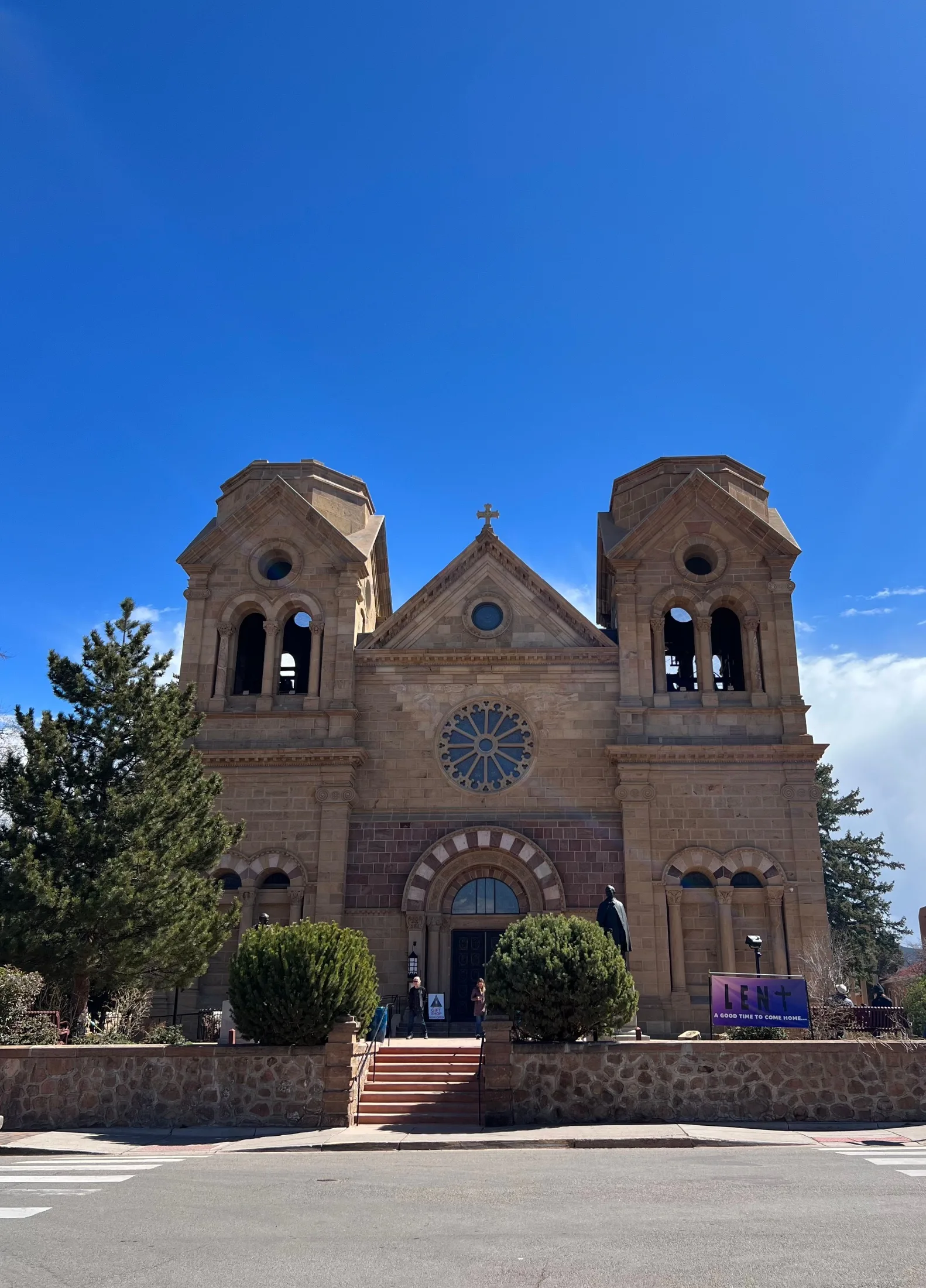
The Cathedral Basilica of Saint Francis of Assisi sits at the east end of San Francisco Street and has been orienting people in this city since the 1880s. Living near it means you use it as a landmark without thinking — turn left at the cathedral, meet me by the steps, walk past the bronze statue on the way to the Plaza. The Romanesque towers stop out-of-towners cold every morning; for residents, it's a quiet anchor. History you pass through, not history behind a velvet rope.
The Architecture Is Not Decorative — It Is the City
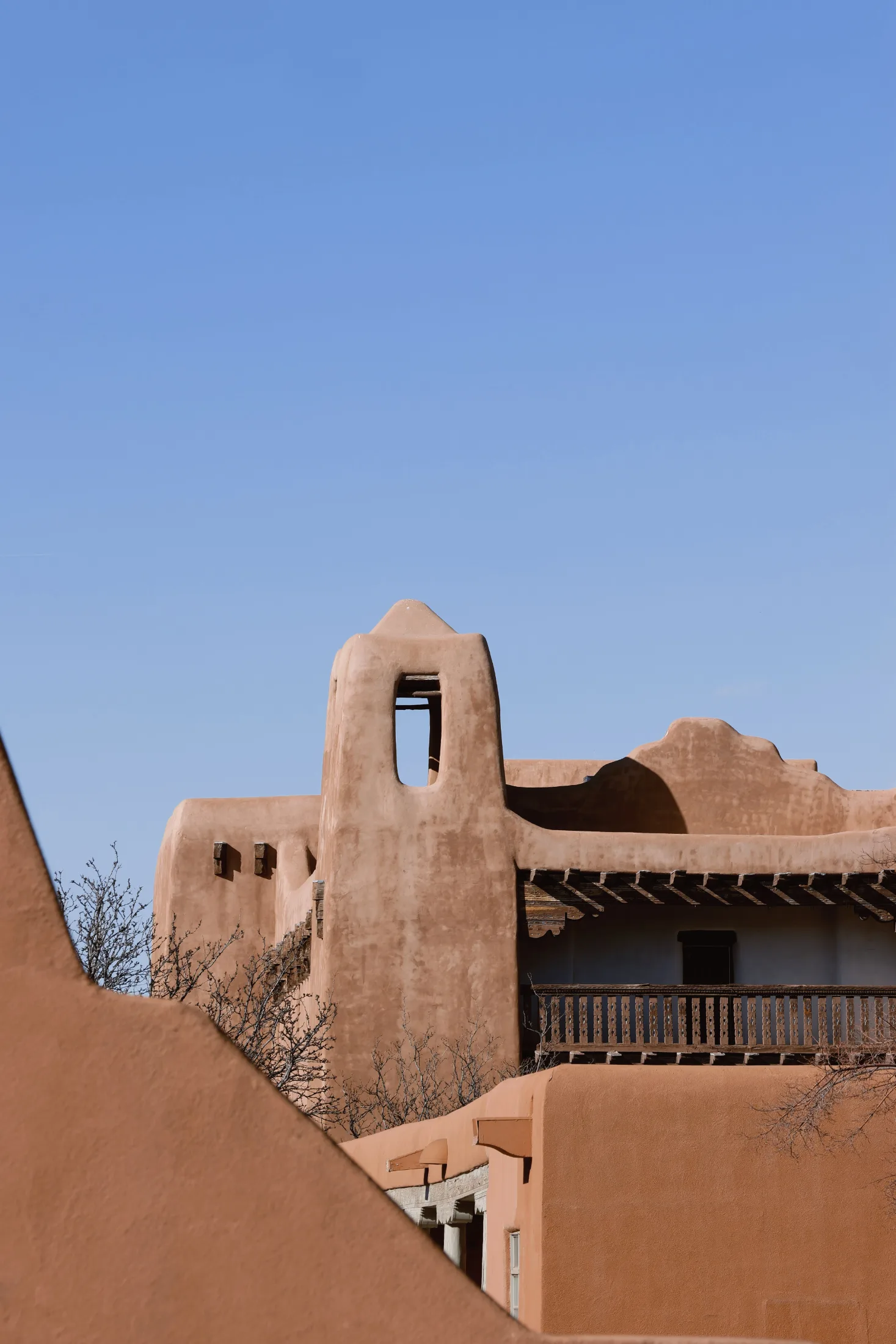
Santa Fe's building code requires adobe or Pueblo Revival style in much of the downtown core, and the effect is not monotony — it's coherence. The walls are the color of the earth they came from. Walk the blocks around the Plaza and buildings stack upward in stepped profiles, flat roofs, and wooden vigas poking through stucco. The whole streetscape reads as one continuous thing rather than a collection of individual buildings competing for attention. You notice this most when you come back from a trip somewhere else. Other cities feel loud. Santa Fe feels like it knows what it is.
That coherence shapes daily life in small ways. Shadows fall differently on curved walls. Sound moves differently in narrow adobe corridors. Rooms stay cool in summer without mechanical help because walls thick enough to absorb heat through the day release it slowly at night. People who move here from glass-and-steel cities often say the same thing in the first few weeks: the buildings feel like they belong to the landscape rather than sit on top of it. That took generations of building in a specific way to achieve, and it shows.

What the Daily Rhythm Actually Looks Like
Santa Fe sits at roughly 7,000 feet above sea level, and the altitude sets a pace. You walk slower your first week. You drink more water. Then you notice the city isn't in a hurry either. Mornings on the east side of the Plaza run at a different speed than mornings in Dallas or Phoenix. People stop to talk. Conversations happen on sidewalks without anyone checking their phone every thirty seconds.
The city has a serious art market — galleries on Canyon Road alone number in the dozens — but residents experience that less as a scene and more as a permanent background hum of craft and intention. You walk past a gallery on the way to get coffee, stop for ten minutes because something in the window catches you, and arrive late. That happens often enough that it changes how you move through the city. You leave more time. You expect to be interrupted by beauty, which is an unusual expectation to build into a commute.
Winters are cold and dry, and the city empties out a little. But the residents who stay will tell you the off-season is when Santa Fe is most itself. The Sangre de Cristo Mountains hold snow on their peaks, the afternoon light turns adobe walls from gold to deep amber, and you have the sidewalks mostly to yourself. That season earns people's loyalty more than any other.
What People Don't Expect — and Can't Leave Behind
Ask someone who moved here from the coasts why they stayed and the answer almost never starts with an activity or an amenity. It starts with a feeling — of space, of scale, of the sky being a presence rather than a backdrop. The Jemez Mountains to the west and the Sangre de Cristos to the east are visible from most of the city on most days. You are constantly reminded of where, exactly, on the surface of the earth you are standing. People who spent years in cities without a visible horizon find that disorienting at first, then indispensable.
The culture runs deep and in multiple directions — Indigenous, Spanish Colonial, and the waves of artists and writers who arrived in the 20th century and never left. Those layers do not always sit easily together, and anyone who tells you otherwise is selling something. But they do produce a city with an unusual density of actual history, and a resident's relationship with that history is something you build over years rather than consume on a weekend.
People move here for the light, the architecture, the altitude. They stay because eventually they realize they've stopped measuring the place against somewhere else — and that the nowhere else they're thinking of is here.